Thinking about work
A New York Times article about workers having to return to the office made me think about work culture.

A student of mine handed in an MBA paper recently that I can't stop thinking about. He interviewed a range of managers and workers about how they were integrating AI in their daily routines. The finding he expected - that workers resist automation, that people protect their turf - was only partially seen. What was more interesting - to me at least - was another thing that went in a completely different direction: Workers were largely fine with AI doing more heavy lifting. In some cases even enthusiastic. The ones who seemed genuinely unsettled were the people in charge.
The managers he interviewed worried not about whether AI would do the job badly. They worried about what happens when it does the job well. If the work gets done by machines, what exactly is a leader leading?
I've been sitting with that question. It sounds almost too simple to take seriously, like something you'd dismiss with a sentence about soft skills and human judgement. But I think it's pointing at something real, something that goes well beyond AI, and has been hiding in plain sight for years.
The Office Altar
Last week Adam Grant, Marissa Shandell, and Courtney Elliot published a piece in the New York Times on why so many bosses are dragging workers back to the office full-time. Their research suggests that the reason has little to do with productivity. The objection to remote work, they found, is more likely driven by ego. Ordering people in, as they put it, is a power and status move.
Leaders want to be worshiped at the office altar.
Read that sentence again: Worshiped at the office altar. It's a brutal formulation, but I don't think it is unfair. There's something about physical presence - bodies in chairs, faces in meeting rooms, people visibly busy around you - that has always functioned as a kind of tribute. You can see your influence. You can feel the organization running through you like electricity. Take away the bodies and something drains out of the role.
This is where AI anxiety and the "return-to-office" push start to look less like two separate phenomena and more like the same one.
Bullshit Jobs
David Graeber, the anthropologist who died in 2020, spend a good part of his career trying to explain why so much of modern work felt hollow even to the people doing it. His book Bullshit Jobs made the argument that a huge proportion of professional roles exist primarily for social and political reasons rather than productive ones. Not because anyone consciously decided this, but because organizations generate a kind of internal logic of their own , creating positions that justify other positions, hierarchies that validate other hierarchies.
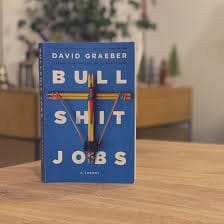
Graeber wasn't particularly interested in technology. But his framework is useful here. If many managerial roles are, at some level, about maintaining a sense of order and importance - about having people to coordinate, meetings to run, visibility to command - then AI doesn't just threaten to automate tasks. It threatens to make certain people's reasons for mattering disappear.
The worker who spends less time on data entry because a language model does it faster has gained something: time, focus. maybe a broader scope of work. The manager who used to supervise that data entry not so much. The supervision was the job. What remains?
Leading
None of this is to say that leadership is meaningless, or that nothing genuinely requires human judgement and presence. That would be too easy, and also wrong. Organizations facing genuinely hard decisions - ethical trade-offs, strategic bets, crises without precedent, need people who can think under pressure, earn trust, and act with some measure of wisdom. AI does not yet do those things well, and may never do all of them.
But there is a difference between leadership as a function and leadership as a performance. The performance involves the office, the meetings, the visible markers of authority. The function involves actually improving things for the people around you and the organization you're a part of.
What my student's research suggests, and what Grant's work reinforces, is that many leaders have quietly substituted one for the other. The performance became the job. And now, with AI thinning out the need for certain kinds of oversight, and remote work dissolving the audience for the performance, the substitution is getting harder to maintain.
Reflections
There's a phrase I've started using when I think about this:
Organizations should not be vanity projects.
It sounds obvious. Of course an organization exists to do something - build a product, provide a service, generate value... But the moment you look closely at how many decisions inside organizations are actually made, the vanity starts to show. Mandating in-person work that demonstrably doesn't improve outcomes. Preserving middle layers of management long after the coordination function has been automated. Holding meetings that exist to demonstrate that a meeting is begin held.
These aren't just inefficiencies. They're signals about what the organization actually believes it's for.
The workers in my student's study weren't naive about AI. They weren't under any illusion that machines were their friends. They were simply running a more honest calculation: This tool helps me do more, do it faster - in a world that already demands a lot from me. So I will use it. The leaders were running a different calculation, one that had less to do with outcomes and more to do with their own positions within a structure that AI was quietly reorganizing around them.
I find something unexpectedly clarifying about that gap. It suggests that the real test AI is administering isn't a test of skill or adaptability. It's a test of honesty - specifically, the willingness to ask what you're actually contributing, now that some of what you used to contribute can be done by a model running on a server somewhere.
That's an uncomfortable question. It's also probably the right one.


