The Subscription of Everything
You used to own your software. Then one day you didn't. Here's how that happened, and what a two-letter word on a Windows desktop has to do with it..

My first computer was an old Windows 95 machine. My uncle let me have it when his office upgraded their gear. It wasn't anything special, I could use Word and Power Point on it - which was the reason my parents agreed to getting the machine - and it ran Age of Empires more or less decently. I was not really that much into computers at the time, but I had a certain sense of pride when it came to this machine. Because it was mine.
My computer.
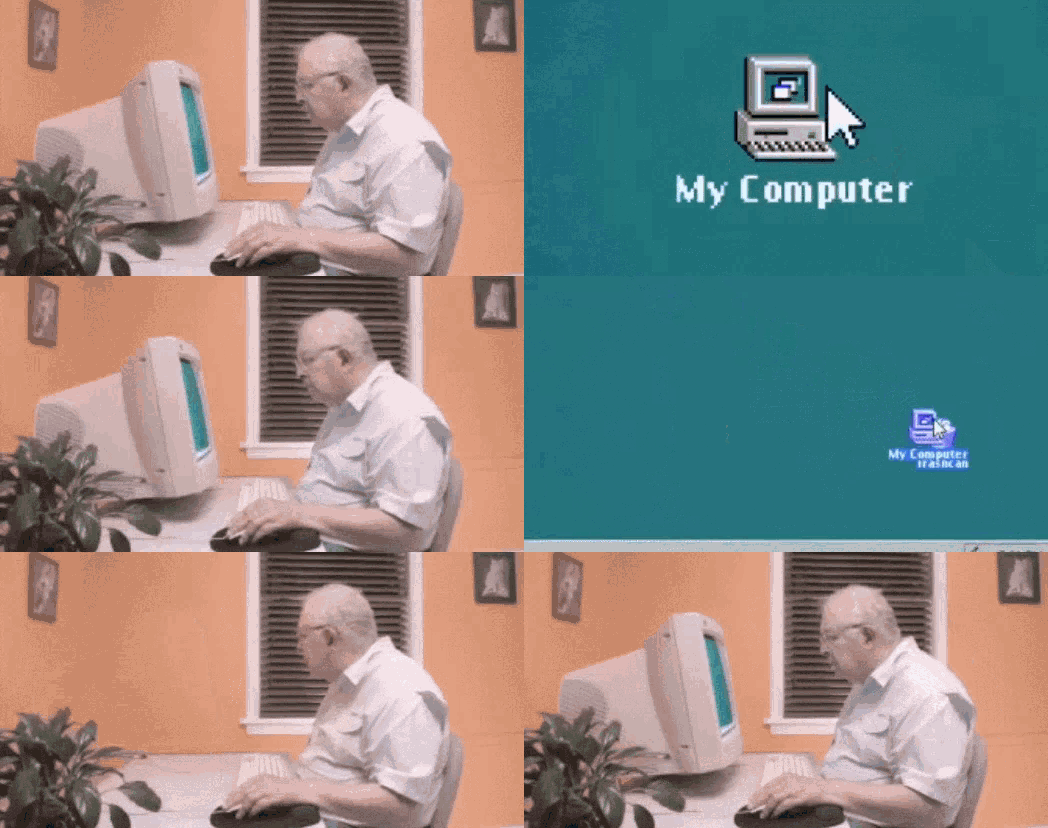
For seventeen years - from Windows 95, which released in August 1995, all the way through Windows 7 - when you sat down at a PC and wanted to look inside it, to see what was there, to feel the basic fact of the machine being yours, you clicked on an icon called "My Computer". "My Documents", "My Music", "My Pictures". The whole desktop was organized around this possessive, this little anchor of ownership. Whoever designed this had an intuition - maybe not even a conscious one - that the experience of using a personal computer should feel like ownership. Like the thing belonged to you.
Then Windows 8 released, and it was gone. The icon now said "This PC". Not mine. Just... this one. The one you happen to be using.
Now, I'm not the first one to notice this change in terminology. The reason I can't get this out of my head is most likely because I've seen it more the once during the last days mentioned somewhere on social media. I don't even think Microsoft did this as some kind of declaration. The reality is probably way less sexy - it tested well in focus groups or a designer thought it sounded cleaner, more modern, different. But it is striking how precisely the language shift mirrors a transformation that was already underway in the broader tech industry - a transformation in who, exactly, your computer is for.
The End of the Transaction
Here is something worth sitting with:
In 2013, Adobe - the company behind Photoshop, Illustrator, Premiere - the tools that a generation of designers and filmmakers grew up buying - stopped selling their software. Instead of purchasing a license you now had to pay a monthly fee. The product was rebranded to Creative Cloud. The cloud being - notably - not your harddrive.
This was a watershed moment, even if it didn't feel like one at the time. I personally stopped using any Adobe products out of principle ever since, but many people didn't. Adobe's revenues grew by a remarkable amount year after year. The logic wasn't complicated: A customer who pays once and owns a thing is a transaction. A customer who pays every month - forever - is something closer to a dependency. Microsoft followed, turning Office into a subscription. Then came the streaming era - music, film, television, games, books... The entire category of "things you used to own" quietly became "things you access while your subscription is on".
What is remarkable is how natural this came to feel. The subscription model sold itself on convenience, on always having the latest version, on not needing to worry about losing a disc. And for a lot of people, for a lot of use cases, those arguments were genuinely true. But there's something buried under the convenience that's worth excavating: When you move from ownership to access, the power dynamic between you and the company flips completely.
When you own something, the transaction is finished. The company got your money - you got the thing. Whatever happens next - to the company, to the market, to the terms of service - the thing is still yours. But when you access something, the transaction is never done. It repeats every month.
Engineered to Trap
A 2024 FTC/ICPEN joint review found that 76% of subscription services - across 642 websites and apps, examined by consumer protection authorities from 27 countries - used at least one "dark pattern": a deliberately confusing design that makes it harder to cancel than to sign up. This wasn't a fringe finding about bad actors. It was the norm.
Amazon is the case study. For years, the company routed customers who wanted to cancel Prime through a process it internally called the Iliad Flow - named, presumably with some self-awareness, after one of the longest poems ever written. It involved multiple pages, multiple offers to stay, multiple opportunities to get lost or give up. Amazon executives knew about it. Internal documents showed they had calculated exactly how much revenue each additional hurdle generated. They kept the hurdles. In September 2025, after the case went to trial, Amazon settled with the FTC for $2.5 billion - the largest civil penalty in the agency's history for a rule violation.
The Iliad Flow wasn't a bug or an oversight. It was a product decision. And Amazon was not alone - it was just the one that got caught at sufficient scale to matter.
The average person now manages around twelve active subscriptions. There are apps - themselves subscription based - designed to help you track and cancel all the other subscriptions. The system has become so complex that it spawned its own management layer, and that layer monetized the complexity right back at you.
This is what subscription fatigue means, and it is not just a marketing term. A 2024 Deloitte survey found that 44% of consumers canceled at least one streaming subscription in a single six-month window, and 64% said they were frustrated with rising prices. Not because the service got worse. Just because the weight of it all - the auto-renewals, the price hikes buried in emails, the four click cancellation flows - had become too much. The convenience had curdled into something else entirely.
The Architecture of Dependency
I want to be careful here not to make this sound like simple nostalgia for a time when things were better. They weren't always better. Plenty of software was terrible and expensive and never updated. The subscription model genuinely democratized access to professional tools and services that once required thousands of dollars upfront. There is a version of this story where monthly fees are a fair trade.
But there is another version - and I think it's the one that actually has been playing out - where the logic of the subscription model, once internalized, pushes relentlessly in one direction: toward lock in. Towards making it easier to start and harder to stop. Toward accumulating dependencies in the customer that the customer did not fully sign up for. You started paying for software and ended up with your files in formats only that software can open, your work history on their servers, your muscle memory trained on their interfaces. The switching cost becomes enormous. And the companies know it.
This is called "vendor lock-in", but that term feels too technical, too bloodless, for what it actually describes: a deliberate arrangement in which your continued use of a tool makes you progressively less free to stop using it.

What the Pronoun Reveals
So I come back to that word - "my" - and what it meant, and what replaced it.
"This PC". The demonstrative pronoun is telling. Demonstratives point at things in space: this, that, here, there. They don't establish relationship. they locate objects. When you say "this PC", you are describing a piece of hardware that exists in front of you , the way you might say "this chair" or "this bus stop". You are not claiming it. You are just indicating it.
Maybe that is the honest version of what personal computing has become. Not my computer - an extension of self, a tool I own and control - but this computer, a terminal through which I can access services maintained by others, on whose platform my work lives, whose terms I accept without reading, whose subscription I renew because the alternative is losing access to all my years of my own output.
The machines got faster. The interfaces got cleaner. The prices, broken into monthly increments, look smaller than they are. But look at what happened to the pronoun and you start to see the shape of the whole thing. The word my promised something - a relationship between a person and a tool, a relationship defined by ownership, by finality, by control. Dropping it was not just a design decision. It was an accurate description of a future that was already being build.
You just weren't consulted if you wanted to live in it.


