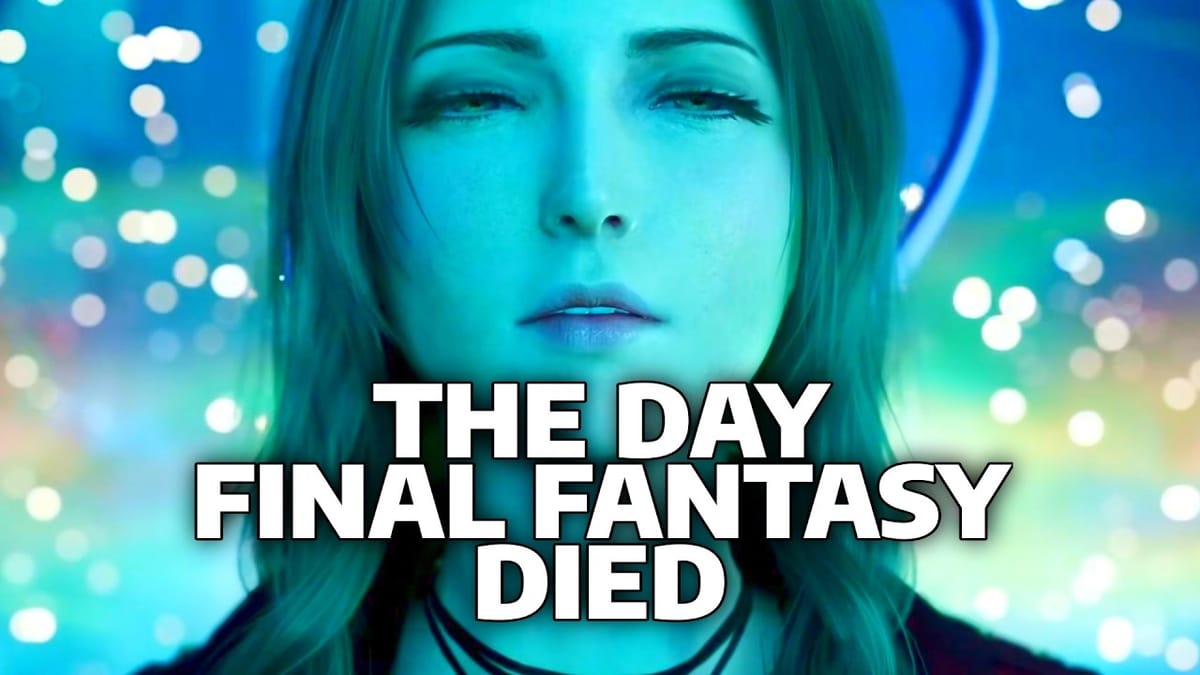
The Day Final Fantasy Died
Final Fantasy was once more than just a video game series — it was an experience that made you feel something no other RPG could. But at some point, that magic disappeared.
Final Fantasy was once more than just a video game series — it was an experience that made you feel something no other RPG could. But at some point, that magic disappeared.
In this video essay, I'm breaking down exactly what changed between the classic era (FF7-FF10) and modern entries (FF13-FF16). I'm analyzing the design philosophy shifts, narrative tone changes, and the critical elements that made older games resonate on an emotional level.
This isn't a blind hate video — it's a thoughtful analysis of why the feeling changed, and what Square Enix might need to recover.
The golden era (VII, VIII, IX, X) was steered by Hironobu Sakaguchi, the series' creator. FFVII was a 1997 revelation: first fully 3D entry, cinematic cutscenes, shift to PlayStation CDs for larger scope. Its true revolution was ambition: first Final Fantasy deliberately marketed to the West, with a story tackling identity, trauma, and corporate exploitation of the planet—complexity rare for games at the time. Gameplay woven into narrative: magic required equipping materia, sacrificing stats, making every choice feel meaningful. Composer Nobuo Uematsu and character artist Tetsuya Nomura cemented its legacy, leaving the author with childhood memories of staring at their TV, stunned a game could evoke such profound emotion.
FFVIII was the series' boldest experiment. Controversial for confusing Junction/Draw systems and moody protagonist Squall, it is often dismissed for plot holes and esoteric time-travel elements. Its value lies in its daring: a genuine, clumsy love story prioritizing narrative and character over mechanics. Fans remember set pieces (Esthar, space station, orphanage reveal) not combat, proving a game can stay with players even when systems frustrate.
FFIX was a deliberate return to series roots: traditional fantasy aesthetics, chunky polygons, classic party structure. It became a masterpiece anchored by deeply human characters: Zidane the secretly wounded thief, Vivi the terrified black mage, Steiner the bumbling but brave knight, Garnet the princess choosing her own path. The author calls it the most gentle, most human Final Fantasy—a game that feels like spending time with people you care about.
FFX was the first fully real-time 3D entry, no prerendered backgrounds, set in Spira. Its story of acceptance and sacrifice (Tidus, a dreamer from another world, and Yuna, a summoner destined to die) foreshadows its own ending from the opening theme. The sphere grid progression and faster combat set new standards; even corny voice acting felt earnest. The author marks X as the final note of the golden era.
The catalyst for shift was Sakaguchi's departure. His passion project Final Fantasy: The Spirits Within (2001) cost $130-145M, grossed $85M, losing Square $120-137M. Square merged with Enix in 2003 for survival; Sakaguchi left the same year. In 2024, Uematsu announced he would no longer compose full RPG soundtracks. The two creative pillars were gone.
Post-golden games are not objectively bad, but fundamentally different. X-2 was fan-service, upbeat pop-focused, a 180 from X's drama, clearly monetizing the original's success. XII, spearheaded by Hiroyuki Ito and Yasumi Matsuno (Final Fantasy Tactics), shifted to political worldbuilding over character development. Matsuno left mid-production due to health; the game held the Guinness record for longest development time. Action-leaning combat and political focus left fans hoping it was a one-off.
FFXIII tried to return to the X formula: turn-based combat, sphere grid-like progression, character-driven storytelling. Derided as "the hallway game" for linear, exploration-free maps—a choice that worked for X's pilgrimage narrative but clashed with XIII's open, vague storyline about gods and chosen ones. By the time the game opened into a larger world, content felt like filler.
Versus XIII (later XV) epitomizes era missteps. Announced as dark, mature action spin-off led by Nomura, it languished for seven years before rebooting as mainline XV under new director Tabata. Launched 2016, it was a solid action RPG with fun road trip vibe, but lacked original vision. The author never finished XV, citing endless traversal, excessive loading screens, and story locked behind DLC.
FFXVI (2023) got solid critical reviews but sharp fan backlash, with headlines declaring it "not a real FF game." It abandoned core staples: no party system, no turn-based combat, no meaningful exploration, real-time action akin to God of War. The author argues it feels like a Ubisoft game: repetitive side quests, bland secondary characters, heavy political focus, optimized for engagement not art. By contrast, FFVII Remake and Rebirth resonate because they retain party system, materia, and core Final Fantasy feeling.
The thesis: new games are not bad, but not the same. More action-oriented, streamlined, Western in design, prioritizing broad appeal over Sakaguchi and Uematsu's weird, experimental, feeling-driven vision. Golden era games felt like discoveries—secrets unfolded layer by layer, made with belief games could be art. New games feel like products: well-made, optimized for consumption, lacking original soul. The author mourns this loss, but refuses to let go of old games, which still hold power to move them. True Final Fantasy lives in Midgar, Timber, Lindblum, Zanarkand—preserved in memory, playthroughs, and fans' hearts.